This hotel-inspired hospital is designed to make high-risk pregnancies feel less scary
· nate berg
Source Summary
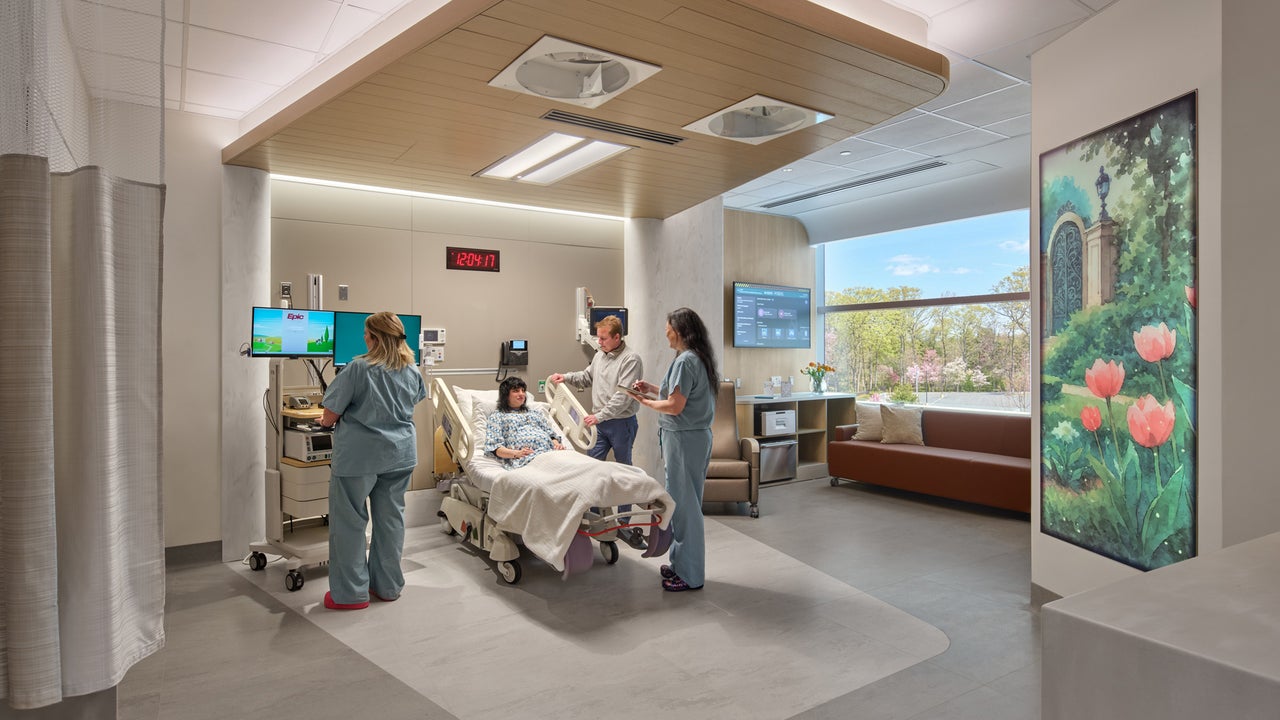
Squint and you might see what looks like a hotel room inside Nemours Children’s Health , a pediatric hospital in Wilmington, Delaware. The hospital’s new Advanced Delivery Unit—which treats patients during the complicated, long, and fearful process of going through a high-risk pregnancy—is much more akin to a guest-centric boutique hotel than a sterile labor and delivery ward. For a hospital, it offers an uncommon, but much-needed, level of hospitality. “What people think of these sorts of worst-case scenarios is, ‘Well, I’m going to end up in some horrible ICU setting. It’s going to be in a lab space or something,'” says Dr. Julie Moldenhauer, a maternal-fetal medicine specialist at Nemours Children’s Health. The hospital upended that expectation and designed a space that feels “like a home away from home,” she adds. Moldenhauer and her medical colleagues at Nemours worked closely with the Chicago-based architecture firm Perkins&Will on the unit’s design. It minimizes the stress and anxiety that comes with a high-risk pregnancy and accommodates the weeks, or even months, of care mothers and babies require before birth and postpartum. “It’s not like you’re coming into a hospital, giving birth, and leaving in a couple days,” says Perkins&Will’s Laura Ethridge Morris, the project’s lead designer and a healthcare interiors specialist. “You’re kind of moving in.” [Photo: Halkin Mason/courtesy Perkins&Will] Designing for the family first The Advanced Delivery Unit treats fetuses diagnosed with anomalies that put them at risk of birth defects, congenital diseases, or even death. It also uses practices from the world of hotels and hospitality to ease the psychologically challenging weeks and months mothers experience before and after giving birth. Each room in the unit features elements commonly found in hotel rooms, from spacious bathrooms to distinctive wall art to large windows overlooking the Nemours estate , built in the early 1900s by the du Pont family. They’re outfitted with cabinets and shelves for food and personal items a mother and her family might need during extended stays. Families can take breaks, have meals, or work here, too, thanks to desks, standalone phone booths for private calls, and lounge spaces overlooking the estate grounds. The unit also has family pantries, which are large enough to host family dinners, baby showers, and other gatherings without having to cram people into the clinical setting of a hospital room. “It’s almost like a multipurpose room for the patients and the families to use while they’re there with us, which is unheard of on labor and delivery units,” Moldenhauer says. [Photo: Halkin Mason/courtesy Perkins&Will] Balancing specialized care But the unit is still a hospital, and nurses and doctors often come and go. While that movement is unavoidable, it isn’t obtrusive. The unit rooms offer as much privacy to patients as possible, with care team areas set right next to each room’s door that can be fully closed off from the rest of the room. “It was very important to this team to be directly adjacent, but not feel like they’re in the family’s way or in the patient’s way,” says Morris, the designer, noting the care team can have the light on to complete their work without interrupting mothers’ sleep. Details like that ease the long stays patients are often expected to have at the hospital, but they’ve also been integrated into how the rooms function during deliveries. Most rooms in a typical labor and delivery unit have areas for what’s known as the “stork team”—the nurses who weigh, measure, and otherwise treat babies in the first moments after they’re born. For the high-risk pregnancies at Nemours, these teams can be upwards of 12 people who are standing by to perform life-saving procedures on newborns. “You can imagine you don’t want them like hovering in the room while you’re giving birth,” Morris says. Each room includes a separate space for these procedures that is blocked from the patient’s view by frosted E-glass. (E-glass, or electric glass, is frosted with the power off, unfrosted with it on.) The stork team can observe delivery without intruding. “As soon as the baby is born, the baby’s handed to the stork team and they can unfrost the glass and the mom can see that they have the baby, that they’re taking care of the baby, and that everything is going as it should,” Morris says. [Photo: Halkin Mason/courtesy Perkins&Will] Preparing for the unpredictable The unit is also designed and wired for when things don’t quite go as planned. “These moms are also high risk to give birth at any point in time,” Morris says. “In every space, even in the family lounges, even in the respite spaces, we had to allow for the infrastructure that if mom went into labor right there and they didn’t have time to get her to a labor room, we could roll in everything they need.” It’s an unusual level of preparedness, but one that matches the unpredictability of high-risk pregnancies. And though the unit includes many elements that account for the challenges that come with these pregnancies, it was important to both the clinicians and the designers that the patient experience was as comfortable and calming as possible. Moldenhauer, the maternal-fetal specialist, sees Nemours Children’s Health as a model for delivery wards to follow. “You can have the ability to make it a medical setting, but it can still be very warm and inviting at the same time,” she says.